Wednesday, January 15, 2014

Floods Are Changing Animal Behavior Here

I went out walking between rain storms yesterday and feel like I finally have arrived back..  It just isn't the same without getting "tabano" bites...mangrove grown yellowish flies BITE and leave welts. No mosquitoes, though. Too much rain I guess. But I now have 4 "tabano: bites. Yes, I've "arrived."


Jim just left with two other men to go to the Rio Indio cut off with shovels, a McLeod tool, crow bar etc.  They plan to make culverts and drain some water on the road so cars can pass.  (It has rained inches since we've been here.) Pedro living down that road to the left as you turn right to Rio Indio has water up 15 " in his house, and many caimans were swimming around the house, got his cat and his 20 chickens drowned, too. He left temporarily for Mahahual.  The local government doesn't seem to have much money for road maintence out here.   Men along the road just get together and do some individual projects. A concept dating back to much earlier times in the U.S.

Caiman,  a Caiman crocodilus. Colloquially known as the spectacled caiman, after the bony ridges that encircle its eyes. Caimans belong to the same family as the American alligator (Alligator mississippiensis); they're more distantly related to crocodiles, which belong to a separate family under the order Crocodylia.


The spectacled caiman is found throughout Central and South America, while the American alligator is confined to the southeastern portion of the United States. Crocodiles tend to have V-shaped noses, while those of caimans and alligators are more rounded and resemble U's. The other most noticeable difference is size, as male caimans rarely exceed 7 feet in length; alligators, by contrast, regularly grow to double that size.

 Snakes, , too are coming out of the mangroves which have the tannic acid water (brown) overflowing onto the road.  Even raccoons, usually nocturnal , are coming around the houses during the day for food. A park ranger next door saw a TAYRA.  I had never heard of it before. (check out the tail)


 A Rare white Tayra.
]


Along the roads the garzas (white egrets) are FISHING in the road, and lots of people have seen caiman along the road.  Last week some Mexicans were also fishing in the road, but what I saw were just ones fishing in the gullies at the side of the road.

Well, remember this photo from the last post?

It was just a come-on to get you back to read another post.  We have rented for 6 years now from the same local, small rental car company just outside the airport at Cancun.  They know us pretty well so I ask for "deals."  We were able to rent a larger car for the same low negociated price and thought, why not.  At the very least, we should have less trouble with getting robbed, because they certainly won't think we are tourists. And yes, we did take lots of pictures of it before we left the rental office...:)


Sunday, January 12, 2014

We're Back to the Yucatan Amid Road Flooding and Storms

Hurrah!! We're back in the Yucatan, 21 km north of Mahahual, on the Caribbean, one hour of driving north from Belize.

Yesterday my husband Jim and I rented a car in Cancun, went to Costco and each began piling food into two separate carts with two separate lists. Hurry, hurry. Then off to Mega (huge grocery store to the west of Costco) and once again piling food and supplies into two separate carts. I do the vegetables, fruit, cereals, etc. and Jim does the new juicer, tequila, rum, coffee, cream etc.

We finished at 12:45 PM and started south on Highway 307, with food in the front seat to eat along the way. No time to stop for lunch. A quick stop for gas and again in Limones for a 70 lb. Bag of sweet oranges and off again. We had now driven four hours south of Cancun, and 51 km yet to go to Mahahual. We arrived to our cutoff at 4:45 PM. Not dark yet, not bad.

Why the rush? We simply had to get to our rental house before nightfall. We had been warned of extreme flooding on the dirt roads. We had a choice of two roads and friends along each road had warned us to go the other road. We had to choose one so...it was the Rio Indio road.

Now a stroke of luck.   See the red truck?


 It just appeared ahead of us so Jim could watch to see how deep the truck wheels were sinking and decided we could get through the first huge “pond,” then the next and then the next, sometimes choosing a different side of the road. At least the mud wasn't that slimy, sticky kind. The truck turned to the right at Rio Indio and we had to go to the left.

Well, that's ok, we thought. The worst was behind us. Not so.

Huge “ponds” continued. Sometimes we drove left, some we went right. Then there were those”ponds" that extended completely across the road.


 No decision there. But oops....the road changed from mud to drifted wet sand...you know the kind that tires like to relax in, all the time not revealing the depth of water on top the sand. Darkness was approaching, getting a bit harder to see. Then the tropical rain pour storm hit. Really, really hard to see. Windshield wipers were only a little help.


And then like a beautiful yellow apparition, we arrived to Casa Amarilla, our home for the next month, But Chaac was not so easily appeased. 

 We sat outside Casa Amarilla in the car for 15 minutes waiting for the heavy rainstorm to abate. To go outside the car would have been like swimming in the Caribbean which was just 75 feet east of us.

We have decided to just stay “put” the next several days, but what a delightful place to be partially marooned in.

Oh...look at this below.....but that's another story. 


Wednesday, February 6, 2013

OVERNIGHT AT HACIENDA YAXCOPUIL


We made a reservation for the overnight guest room at the Yaxcopuil Hacienda almost 9 months ago. Yaxcopuil is located a few miles south of Mérida, the capital of the state of Yucatán.


Here below we are driving onto the hacienda and through the gates to the guest house. During the early 1900's, the hacienda employed over 500 workers to grow, harvest and process the henequen (an agave fiber resembling sisal.)   It was in operation until 1984.  But now, it offers an opportunity to see an hacienda that has not been restored much and remains in its original (but decaying) state.


Below is where we stayed.  It was where the mayordormo or the "capataz" had lived with his family.


We were delighted with the size of the  room with its original tiles.
Outside the huge wooden doors is your own private garden to enjoy, complete with lilies and the original cistern.


Here above, is the outdoor kitchen, where Aurora and her granddaughter Carolina  prepared both supper in the evening and breakfast the following morning for us..  We certainly enjoyed them.  Aurora even dressed up in her mother's huipil to serve us the food.  We had contracted to have the evening meal prepared at 5:30 PM. The timing, service and food were excellent.


Below, Jim is showing them where Washington State is and our log cabin, etc.

One of our son-in-laws had given us a portable photo printer, so we were able to leave several prints of Aurora, Carolina and her friend for them when we left.  

Aurora's husband, Mario, gave us a detailed tour of the hacienda. We had lunch earlier at the Hacienda Ochil, but weren't able to see many machines at that restored site. So this was a great opportunity.


 Above are water pumps for irrigating the fruit trees.


 Above and below is the big German made engine that turned all the belts which powered the.machines to separate the fibers and pulp from the outside leaves of the henequen.

We also visited the main house where the owner of the Hacienda lived with his family.   Below is a sink from their bathroom.

The food for the owner's family was prepared in a kitchen away from the main area of the house.

The wood (heat source) was added at the side and above the grates were pans for milk,
hot water, and the flat pan for tortillas, etc.

You can also visit the museum which holds many items discovered on the hacienda.


Yaxcopuil Hacienda  was first a cattle ranch before it shifted to henequen.  They still have some cattle.

Here below is the original tienda...called the "Tienda de Rayas."   As most of the workers were unable to write their names, they "signed" with a "raya."  It often resembled a straight line or "raya."  All the food for the workers' families had to be purchased there, their supplies, etc.  and they often became indebted to the hacienda.


This is the entry arch which proudly announced the Hacienda Yaxcopuil.

More on henequen haciendas in another post.


s


Wednesday, January 16, 2013

2013 This time PYRAMIDS of Rio Bec near Guatemala

Jim and I hauled luggage over the snow to our truck at 25 Mile Creek State Park where our truck was located.  We drove to Seattle and left for Mexico on  Wednesday, January 11, 2013.

Saturday, February 11, 2012

Days at Bacalar, Mexico


CARNIVAL AT BACALAR
We had a great time last night at Carnival. Floats of many kinds, people just having fun, lots of people dressed up to celebrate and smiles on everyone's faces.


Mike and Gayle’s Family in Mexico or
We Didn’t Get to Belize

We’re certainly having a great time with Mike, Gayle, Calin and Marley first in Rio Indio (El Placer) and now in Bacalar which is a town to the southwest.

We were going to visit Belize for three days. But the Mexican government apparently has a new law since January, 2011

A TALE of WOE!!

We had made 2 copies of all our passports, permission of the rental car to enter Belize, two copies of the paper inserted into our passport, knew to ask for double stamp, etc. We had read scores of tales of how to pass into Belize from Chetumal on line...WE WERE READY...WE WERE READY!!!

First as we just approached leaving Mexico, a sort of official looking man told us we had to immediately get Belize auto Insurance...."nope...I said we were buying it in Belize.."   "No," he said. "Here (in Mexico);" "No," I said "In Belize".....He gave up on that. We knew better than to believe him.

Then we were pulled over and we approached the iron barred concrete building “they” informed us of a new law...since Jan, 2012....that we would have to pay a departure tax from Mexico...well, we paid the departure tax with our airplane ticket. We showed them the paper work. NOPE...not detailed enough. We would have to spend 295 pesos times 6 (even have to pay for the 3 and 5 year old)...that is almost 180 pesos....that is just to leave Mexico. Approximately $160 American dollars)

So then this same man who tried to get us to immediately buy Belize insurance in Mexico said he would show us the bank where we were to spend the 295 times 6 just to get out of Mexico...”Pay the money, they will give you a receipt, and then you bring the receipt to us.”

.WE HADN’T EVEN GOTTEN OUT OF MEXICO!!

So let’s see. We STILL have to pay to get INTO Belize, then Belize Auto Insurance, then the spraying of the car. ($5 American Dollars each).

THEN we’ve have to pay ourselves out of Belize and into Mexico for just three days....

Were any of the NEW rules written in English nope...all in Spanish. I speak pretty fluent Spanish and the written explanations were not even suitable for a lawyer.

I kept the paper that I WAS to take to the bank and pay. The official wanted it back. I NEVER gave it to him because I need it to show everyone that is ever thinking of going into Belize how much it is going to cost them.

WE WERE SO angry, we all decided to BAG BELIZE. We have have 3 great dinners just on the money we were to pay LEAVING Mexico, not to mention all the rest YET to come. Now we’re in Bacalar having a great time.  Great Decision...


Monday, January 30, 2012

Days at Casa Amarilla


Banco Chinchorro
January 28, 2012


We finally made it to the Chinchorro Reef (Banco Chinchorro)
It’s the second largest reef in the world after the Great Barrier Reef in Australia.

The reef is around 25 miles long, and is comprised of three islands, Cayo Norte, Cayo Central and Cayo Lobos. The atoll is a continuous reef with six entries to the more shallow inside. It’s about 19 miles out from Mahahual where we left.


Last year we tried to go, but the weather didn’t cooperate. In late 2011, wrote to Dreamtime Dive Resort to enquire about a possible trip, cost, etc. and agreed to meet with them the first day of our stay in Mexico which we did. We waited 6 days and Saturday was predicted to finally be a calm enough day to go. We were only 4 and a minimum to go was 6. The two scuba guys cancelled, but they found 2 French couples.


Then our email went down, the telephones wouldn’t work, Marcia, at Mayan Beach Gardens allowed me to use her computer for email and plans were finalized for the morning.


We arrived by 8:30 PM. As we were snorkeling they provided us with a facemask, snorkel, fins, and a lifejacket for the trip. (and lots of water, soda, fresh fruit and snack bars and later sandwiches.). Chencho was the man whose boat had the license, Jose was the boat captain and Pedro the lookout. We were a group then of 3 Mexicans, 4 French and 4 Americans. The French turned out to be delightful boat companions, too.


As we had an unusually calm day, our trip out from Mahahual took about 55 minutes instead of two hours. Well, that was supposed to be the time, but it was a little longer because dolphins were sighted. We turned around a bit, and suddenly they were with us for a long time…right along side, many in front, and the wonderful fast swimming and up, up out of the water at times, leaping.


Then what surprised me most. The flying fish. I had heard of them before and thought that they would perhaps jump out of the water and go 10 feet. Not so. They flew and flew and flew…..many times 50 feet without popping back into the water. They shined silver in the sunlight and you could see their delicate “wings.” Plenty of time to tell others to watch and the fish just kept flying. Jim saw six flying all at once.


We did three snorkel dives, all on the eastern side of the reef. The captain was very careful finding his way through the reef to the east side.

There are anywhere between 30 and 200 wrecks in total at Chinchorro. The list of ships that have ended their days on the reef is long and includes the Cassel, Far Star, Tropic, Huba, San Andres, SS Caldera, SS Escasell, SS Ginger Screw, SS Glen View and SS Penelopez just to name a few, and others so torn up, only their canons and the river rocks they used for ballast are left.
The first dive was with all kinds of colored tropical fish. I also marveled at the yellow balls, the size of basketballs or larger, that appeared to be some kind of brain coral.  To see healthy, colorful coral was also a delight. Chinchorro harbors 70 species of soft and hard, or rock coral.  (Diploria labyrinthiformis, also known as the grooved brain coral, is a brown or yellow hemispherical-shaped reef-building coral occurring in the Caribbean, the Bahamas, southern Florida, and Bermuda (Humann, 1993). It is most commonly found on offshore reefs at depths between 1 and 30 meters, growing to about 2 meters in diameter (Sterrer, 1986). Bermudian brain corals such as D. labyrinthiformis grow upward at a rate of about 3.5 millimeters per year.)

Afterward we were a bit cold so ventured onward way out to the wreak of the Ginger Screw. Very spread out and only a few feet below me, I could imagine the sinking of this shrimp boat in 1956.…pipes, props, anchor, and bow.

Then we were off to the Central Cay.

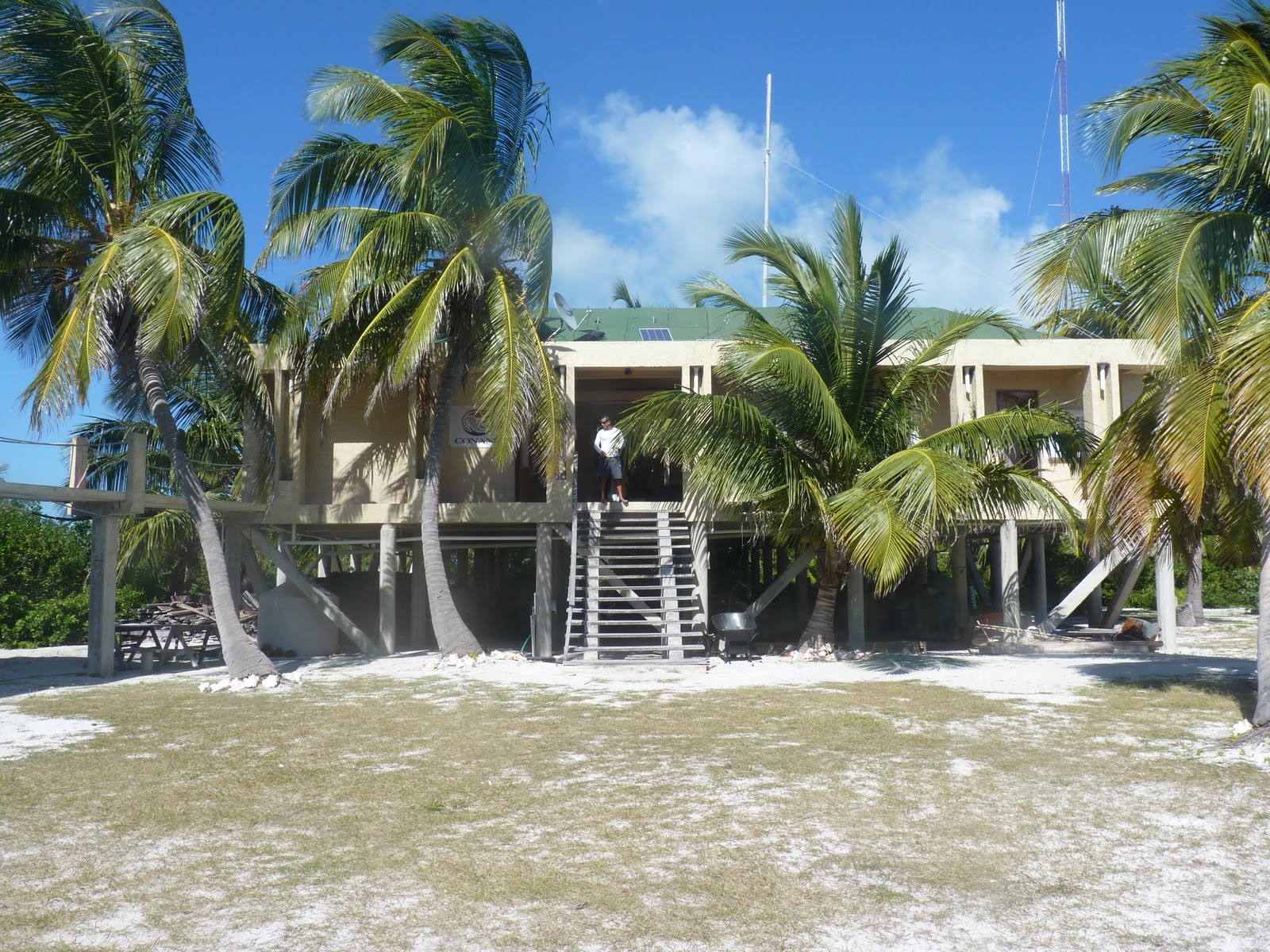
It is a long island with several fishing huts built out of wood and some painted on one end, mostly occupied with friendly fisherman. There is also a two story concrete buildings that are said to house the scientists that come to study. It is the central hub of the Chinchorro National Park. However,  We saw very little occupation in that area.


The inner lagoon has crocodiles that come to see if you’re bringing food.


But the Iguanas are the most stunning. The dewlaps (skin under the head) of the older iguanas are very impressive. They don’t like you to get too close, but otherwise seem unafraid.


Then farther to the south, by boat, we arrived to fishing huts that are on poles above water and we had lunch in the very one (above) that is featured in the movie Alamar, an award winning film that features a father and a son bonding during a trip to the area. The owner allowed us complete access to his wonderful hut including the "toilet" over the water.  He was smiling and cleaning fish for Chencho to take back to Mahahual.  We saw many frigates, seagulls and pelicans there.


After lunch we went northwest and snorkeled in an area with star fish. Also I saw three large turtles. One was “hiding” and we could watch him a long time. Each time we “dove,” Chencho and Pedro were in the water with us with bright flotation devices so we could see them. As there were swells and so much to see it was very e asy to spread out too much and they provided us with extra safety.

Coming back with the wind, we quickly returned about 5:30 PM. The cost was $125 American dollars or 1500 Pesos per person. Only 20% of those who try to go to Banco Chinchorro are successful, so we feel very privileged to have gone. There are few boats licensed to go, no one is allowed to go without being in a licensed boat by the Mexican Federal Government, and more important than all are the heavy seas so constant in the winter when most tourists wish to go.


January 25, 2012


Punto Herrera Fishing Village

We left Casa Amarilla at about 7:30 AM to begin our drive to Punto Herrero. We entered the dirt road in front of our rental house, finally turned off of it onto the Jungle asphalt road and drove north until turning right onto the road to Puticub. We took a left and soon were again on a dirt road with fairly deep potholes…lots of rock. Then the road turned to more sand than rock and the driving was easier. We passed Punta Mosquitero and on past a few native dwellings, many abandoned, view points, and finally arrived at about 9:30 AM. We stopped and talked to several fisherman about the possibility of taking us out in their fishing boat to the large Bahia Espiritu Santo. ( Holy Spirit Bay) in the Sian Ka’an Bioreserve.Biosphere Reserve


We finally ended up with Victor Ocun and Serio Moreno. Victor is in a 5 part program preparing him to be an official guide in the Bioreserve and is also President of the newly formed Tourism group in the village. He speaks English, but Serio does not.
We climbed into their boat and sped out toward a finger lagoon bordering the Bahia for about an hour seeing many kinds of birds and then back out and into the actual Bahia Espiritu Santo. It seemed huge to us.
We approached one island and Victor explained that before the hurricane Dean in 2007, it was alive with birds, especially the Roseate Spoonbill. We sped on and found the new site of the birds….they were cautious about us approaching, so Serio turned off the engine and we floated quietly toward the island. He turned on the engine as we swung around the island and approached the island from the west where they were perched. Many flew away, then came back. We entered a small cove and sat. The birds came back and then we noticed white Heron eggs in nests in the trees. That time was magic..bird calls, chattering and scores of Roseate Spoonbills alighting and flying, then returning again.

Next we went snorkeling in a small flowing riverlet. I saw whelps (like Conchs) walking along with their big black muscles extended. We also saw tubes with white rings suggesting a Pacific NW seaworm, but they are Whelp eggs that change into sharp pointed white eggs that adhere to rocks, etc. The water was low so we were right into the sand seeing things. Lunch, then back to the fishing village. Here is a photo of one fisherman's kitchen.  They lead a simple life there.


On the way back we stopped at the Mosquitero Restaurant and were given a choice of a tray of fresh, whole, uncooked fish.  We chose Pargo this time and the fish was cooked outback on a oil barrel.  It was delicious and we were surprised to be also given rice, beans, cucumbers, salad, and home made tortillas.

From Mayan Beach Gardens it takes about 2 hours of slow driving on dirt roads for the most part and lots of potholes. We didn’t need a 4 wheel drive because it is the dry season. I imagine it would be very gummy and difficult in the wet season. We paid 1300 pesos plus tip for the 4 of us for about 4 hours. We brought our own lunches with us.

We highly recommend the trip.


We moved 5 km south of Casa Maria to Casa Amarilla owned by Jerry and Lynn Zimpleman (caretakers Hugh and Deb Blackburn).  We LOVE the house.  The best is the screened porch.  We LIVE there....the house is about 30 feet from the white sandy shore.

The tiles are slightly ridged so you don't slip; they are the color of sand and earth so they don't show sand or dirt; the lounge chairs have charteuse green comfortable cushions and there is a table for at least 8...plus a gas barbecue.  The salt does adhere to the screen, but it mostly looks like glass.  Long, long sliding glass doors separate it from the living room and those are locked at night.

Two bedrooms, an alcove with a futon for the children, a fully equipped kitchen with a central island that looks out through the sliding glass doors directly to the Caribbean.


The plan of the house is totally to my liking.